Blog Archives
Comments Off The Week in Pixels #17

Usually, when we make a mistake, there’s this tendency to want to go back in time. An impossible task, to be sure (and then, only Marty McFly could do it) and one that would ignore something crucial: mistakes or not, our decisions build our character. When a few years ago I found myself going through an existencial crisis that saw me abandoning videogames and writing about them, the desire to go back was gradually replaced by a certain acceptance. It was a choice made in full possession of my mental faculties and the cross to bare was mine alone. I’ve made worse decisions and I still live with them and I suspect many other people share the same experience. So when I’m confronted with chances to, in some way, redeem myself I don’t know what to think. When I got an invitation to work in Smash! magazine, I didn’t hesitate (spoiler: might not be entirely true). When this week sees a late Christmas present arrive by mail, in the form of The Legend of Zelda: Wind Waker, the world goes into “bullet time”. Once in my possession, it was sold in cold blood and became associated with other kinds of losses in my life. Now that I have a chance to return, arguably, to the best Zelda game ever created, I’m not sure what to think. To say that I will play it is a truism but it will be curious to return to Miyamoto’s maximum expression of wanderlust while trying to abstain myself from thinking about the double meaning the game now has. Overly gushy, they say. Something more interesting, then:
- An excerpt from 1958′s Disneylanf TV Show called Magic Highway USA, which ponders over the future of transportation technology. It’s an artefact very much of its time, with a radical vision of optimistic future clashing against the traditional roles of men and women in society (in other words, highways could me magical and futuristic but it was the man who would dominate them, while the woman was still chained to the role of the housewife).
4 No útero frio do oceano
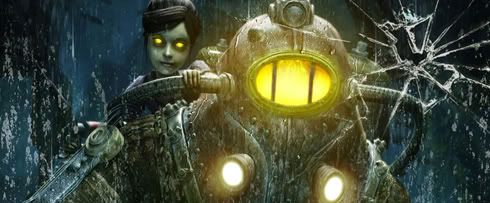
Muitos preferem patrulhar as fronteiras dos géneros do que explorar os baldios sem definição. Talvez por isso Bioshock tenha despertado entusiasmo e estranheza em igual medida. Fenómeno curioso, então, que foi um jogo com direito a discussões filosóficas sobre o livre arbítrio mas que quando chegava a hora de jogar, era sobre enfardar em mutantes com máscaras de coelho que andavam pelas paredes. Tudo porque Ken Levine suportou quase sozinho o peso de afirmar que Bioshock era “apenas” um first-person shooter enquanto todas as outras pessoas falavam de como era “mais” do que isso. Nada de novo no território lúdico, portanto: mais uma vez tínhamos em mãos um design de linhagem emergente (Thief, System Shock, Deus Ex) que escondia grandes questões por detrás da simplicidade das suas mecânicas de jogo e mais uma vez tínhamos um design de 19XX que se voltava a tornar popular em 20XX. Para uma certa elite de jogadores de PC, era alvo de escárnio; para as massas de jogadores de consolas, era um diamante mais brilhante do que os shooters cinzentos a que estavam habituados.
O que teve o seu toque de génio: apesar de tudo era sem dúvida uma maneira de dizer que System Shock, mais de uma década depois e com roupagens diferentes, ainda era um jogo capaz de nos cativar. Se neste mundo de consumo rápido o bestial de ontem é a besta de amanhã, e se a linhagem de certos jogos ou géneros perde algum do seu valor face ao enterro contínuo da nossa memória como se a história fosse uma doença, ali estava uma prova de que as coisas nem sempre têm de se reger por essa regra: ainda era (é) possível conciliar o passado e o presente. Longe da perfeição mas muito perto da ambição temperada, Bioshock era mais que prova de que um design pode ser intemporal enquanto há uma fagulha de savoir faire, e como tal, era também mais que prova do talento de Levine e da Irrational.
Talento esse que parece ausente em Bioshock 2.
Dito de outra maneira: Bioshock 2 é um melhor first-person shooter que o seu predecessor. Simplesmente não é um jogo tão bom.
Comments Off In the cold womb of the ocean
Many would rather patrol genre borders than to explore their undefinied wastelands. This is why, perhaps, the reason Bioshock stirred such enthusiasm and weirdness in equal measure. A curious phenomenon, then, to see a game provoking philosophical discussion about free will but realizing that when it came to playing it, was about slapping around mutants wearing rabbit face masks who ran up the walls. All because Ken Levine took it upon himself much of the burden of claiming Bioshock was “simply” a first-person shooter while everyone elese talked about how it was “more” than that. Nothing new in ludic territory, then: once again we had a design of emergent pedigree (Thief, System Shock, Deus Ex) hiding bigger issues behind the simplicity of its play mechanics and once again we had a 19XX design becoming popular again in 20XX. To a certain elite of PC gamers, it was worthy of scorn; to the console gamer masses, it was a diamong shining brighter than the drab shooters they were used to.
Which was certainly a stroke of genius: above all, it was a way of saying that System Shock, over a decade later and wearing different clothes, was still a game capable of captivating us. If in this fast food world the greats of yesterday are the worst of tomorrow, and if certain games or genres’ lineage lose some of its power due to the continuous burial of our memory as if history were a disease, the game was enough proof that things don’t always have to be like that: it was (is) still possible to reconcile the past and the present. Far from perfection but very close to restrained ambition, Bioshock was more than enough evidence that design can be timeless while there’s a spark of savoir faire, and as such, was also more than enough evidence of Levine and Irrational’s talent.
A talent which seems absent of Bioshock 2.
Put it another way: Bioshock 2 is a better first-person shooter than its predecessor. It’s simply not a better game.
4 A Semana em Pixels #16
Já cheguei à edição 16? Hum, yay? Crítica a Bioshock 2 já está pronta, apenas falta limar umas arestas e tratar da tradução – deve estar disponível nos próximos dias. Até lá, prevejo um Sábado e Domingo com queda de Alien vs. Predator e umas aberturas em Endless Ocean 2. Para já, os links da semana.
- A PC Gamer afirmou e a Ars Technica confirmou: a versão de Assassin’s Creed 2 para PC não só requer uma activação online mas também exige que os jogadores estejam ligados constantemente à internet para conseguir jogar e até gravar o seu percurso. Em teoria, isto impede o jogo de entrar no mercado de segunda mão pois a informação fica associada à nossa conta e aos servidores da Ubisoft, e também impede (ou pelo menos atrasa) os piratas digitais. Na prática, isto faz com que o jogo não possa ser jogado offline e que se algo acontecer à nossa ligação ou até mesmo aos servidores da Ubi, é impossível jogar AC 2. Falha de conectividade depois de uma hora de jogo sem passar por um único checkpoint? Azar. Perderam tudo desde a última vez que gravaram.Situações semelhantes têm acontecido com Mass Effect 2 e Dragon Age: Origins, da Bioware. Quando os servidores da Electronic Arts entram em períodos de manutenção, os jogos não conseguem reconhecer os DLC respectivos, o que impede os jogadores de acederem aos mesmos. Qualquer “save” que use conteúdo dos DLCs é considerado inválido até que os servidores voltem a funcionar. Não é difícil perceber porque esta dependência numa ligação constante é uma terrível ideia: problemas com um ISP, falhas num router, interferências em ligações wi-fi, estabilidade precária de redes 3G e problemas nos próprios servidores da Ubi (manutenção ou mesmo a um eventual encerramento no futuro) são apenas algumas das situações que podem acontecer. Sem contar com o mais óbvio: sim, há quem não tenha uma ligação à internet em casa. Se alguma vez existiu uma razão válida para os jogadores de PC fazerem boicote a um jogo, aqui está ela. E falo de um boicote absoluto. Há que suprimir a ideia de que é obrigatório jogar todas as novidades no mercado, e jogá-las independentemente dos custos – quer financeiros quer éticos – associados a isso. Porquê? Porque se comprarem o jogo, vão dar a entender à Ubisoft que aceitam este tipo de sistema. Se piratearem o jogo, a Ubisoft só vai reforçar a sua posição e vai continuar a insistir que este tipo de sistema é necessário. É um ciclo vicioso e viciado, que apenas o consumidor pode ajudar a quebrar. E já chega de instigar revoluções por hoje.
Comments Off The Week in Pixels #16
I’ve reached the 16th edition? Hum, yay? Bioshock 2 critique is done, only thing left is to clear up a few rough edges and work on the translation – should be up in the next days. Until then, I predict a chance of Alien vs. Predator this Saturday and Sunday and some openings in Endless Ocean 2. For now, the links of the week.
- PC Gamer announced and Ars Technica confirmed: the PC version of Assassin’s Creed 2 not only requires online activation but also demands that players to be constantly online in order to play and even save their progress. In theory, this prevents the game from reaching the second hand market since information is inexorably tied to our account and Ubi’s servers, and it also prevents (or at least delays) digital pirates. In practice, this makes it so the game can’t be played offline and that if something happens to our connection or even to Ubi’s servers, it becomes impossible to play Assassin’s Creed 2. Connection failure after a one hour playthrough without passing by a single checkpoint? Tough. You’ve lost everything since your last save. Similar situations have been happening with Bioware’s Mass Effect 2 and Dragon Age: Origins. When Electronic Arts serves are down for maintenance, the games cannot recognize their respective DLCs, preventing players to access them. Any savegame using DLC content is therefore rendered invalid until the servers are back online. It’s not hard to understand why depending on a constant online connection is a terrible idea: ISP problems, router failures, interferences in wi-fi connections, precarious stability of 3G networks and problems in Ubi’s own servers (from maintenance to an eventual shutdown further down the line) are just a few of the situations that may arise. And all this without even mentioning the most obvious issue: yes, some people do not have an internet connection at home. If there ever was a valid reason for PC gamers to boycott a game, here it is. And I’m talking of an absolute boycott. We have to supress this idea that it’s somehow mandatory to play every single new game in the market, and that it has to be played regardless of costs – whether financial or ethical – associated with them. Why? Because if you buy the game, you’ll be telling Ubisoft that you accept this kind of initiative. If you pirate the game, you’re only reinforcing Ubisoft’s position and they will keep insisting that this kind of system is necessary. It’s a vicious and cheating cycle, one only the consumer can help break. And that’s enough fire starting for today.
2 A Semana em Pixels #15

Dei por mim com uma cópia de Bioshock 2 para analisar na Xbox 360, cujo texto vai aparecer no próximo número da revista Smash!. O resultado é um shooter mais refinado mas uma experiência inferior ao original. Um bom jogo mas não mais que isso – o que, considerando o primeiro título e o clima actual de videojogos, até é positivo. Mas há ali todo um potencial que ninguém soube aproveitar. Eventualmente, antes de Fevereiro acabar, devo deixar uma paredezita de texto sobre o jogo aqui. Mas pegar em Bioshock 2 teve pelo menos um aspecto positivo – deixar-me a pensar no original, o que me levou a revisitar a primeira iteração de Rapture e a deixar aqui alguns links relacionados ao jogo.
- Muitas vezes dei por mim a pensar que o primeiro Bioshock devia ter tido apenas uma Little Sister e um Big Daddy, e que a nossa interacção com eles ao longo de várias etapas do jogo devia moldar o final em vez de, como acontece no título da Irrational, assentar numa perda gradual de espanto que foram os encontros rotineiros entre eles. Entretanto, vejo esta incrível performance em Berlin que envolve a reunião entre “um Grande Gigante, um mergulhador de profundidade, e a sua sobrinha, a Pequena Giganta”, para comemorar o vigésimo aniversário da queda do Muro de Berlim e não consigo evitar de me repetir: Bioshock devia ter tido apenas uma Little Sister e um Big Daddy. Tenho bastante respeito por Levine e companhia mas nestas fotos há mais impacto, mais história, mais emoção do que “CARREGUEM EM X PARA SALVAR”.