
In Darkest Knight
We’re somewhere around 1994, I think, and a friend of mine decides that I absolutely must read Arkham Asylum: A Serious House on Serious Earth. For a long time, north-american comics were filtered through Brazil before landing in Portugal and the end result, in spite of being fondly called ‘pocket comics’, was reduced in about 50% of its original size which caused obvious problems. But this copy of Arkham Asylum on my hands kept its proportions intact, each page complete and no cut off dialogues. More importantly, its story and themes introduced me to a Batman beyond my expectations. Of course when you’re fourteen everything looks awesome but Arkham Asylum was, and still is, very good. We need to blame Grant Morrison and Dave McKean for that, names I’ve tried to follow as closely as possible – especially McKean, whose visual art in comics remains one of the few to work in the representation/deconstruction field in a natural way.
When it comes to comics, there are few characters I can call personal favorites. Barry Allen, the second Flash, is one – his sacrifice during the Crisis on Infinite Earths saga, and his revised origin story by Robert Fleming and Carmine Infantino in Secret Origins Annual #2 contributed to that. There are several others but Batman is highest on the list. Of all possible reasons for this, I choose one: because he’s a human character, in every possible way. Not only does he not belong in the pantheon of characters with godlike powers (and I have to confess my profound irritation towards the character’s gradual association with the term “superhero” for that very reason) but he’s also one of those characters whose humanity has been incredibly explored. The psychological predisposition towards a constant struggle against crime, the need for that very same struggle, the moral code, the very suit itself both as an utilitarian (that allows him to conceal his identity and operate in the shadows) and supernatural (the bat as a symbol of death, as a night hunter, as the character’s “soul”) motif have all developed a very strong mythology.
When news came that a relatively unknown studio was to give the Dark Knight a new lease on life, I wasn’t sure what to think. Having played nearly all games created about the character, there was a strong chance this might’ve ended up spectacularly wrong (I believe the technical term is EPIC FAIL). Not because the studio only had one game under their belt but because Batman is a perfect target for productions looking for financing. It’s par for the course in the genre – Marvel: Ultimate Alliance is an excellent example of this for the wrong reasons. There is never a feeling of presence or a larger diversity in its restricted context – whether narratively or mechanically, the difference between a Wolverine and a Thor is virtually none, to the point where we could just have been playing a spruced up version of Gauntlet. The problem is that when you get your mitts on this kind of license, many studios funnel characters into game concepts that have been previously established instead of building a game around a character.
But then Batman: Arkham Asylum comes out, Rocksteady gets it right and many surrendered to the game’s charm. Unsurprisingly, me too. But in spite of all that’s been said about it, I can’t agree that it is a game about Batman. Or even about Joker.
It’s about the asylum.
Bat-spoilers on the way, yes?
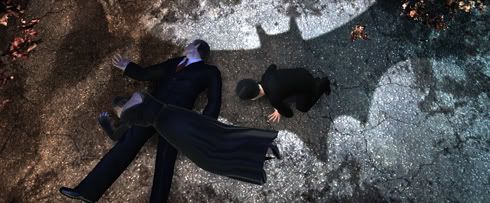
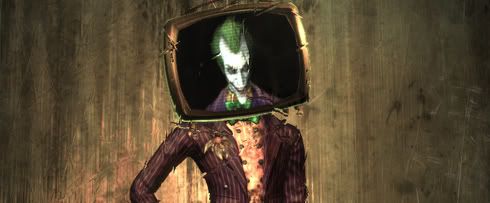
Batman is the character constantly under the spotlight, of course, with unmatched presence in physical (as a character under our control), mythological (with a web of intimate relationships between nearly everything and everyone around him) and visual (we may very well be looking at the character’s finest vision to date) terms. Mark Hamill is still brilliant as the Joker, stealing a lot of the attention from the bat and never hams it up even when the story seems to do so in its final stages.
But the game is not about Batman or about Joker. It’s about Arkham.
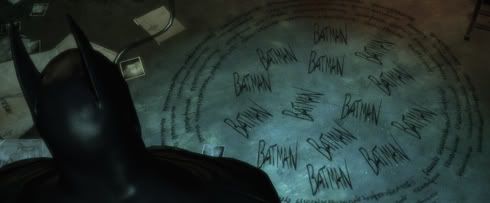
The importance of the asylum in the hero’s mythology is that it works as a counterpoint to the city of Gotham and its crusader. Batman keeps a certain level of security in the city through his vigilantism, but the asylum – even though it tries to offer sanity to its residents – is the place where chaos exists in its purest form. For every moment of triumph over Gotham’s criminality, there is always something in Batman’s subconscious reminding him of the asylum. To enter it is to explore his psyche. A Serious House on Serious Earth has memorable passages that explore this relationship and in Rocksteady’s game, the asylum is also the great narrative engine, the place that tries to sell itself to the world as safe place when the truth is, it’s anything but that – something highlighted in the way how various pieces of story (audio interviews and a number of ghostly chronicles, for instance, the former seemingly a futile exercise in “Pokemonisms” until we realize who left them across the asylum and why) offer small glimpses of what really happened inside.
Randomly, two of my favorite examples on how the importance of place can be established:
1) The Thing (1982), by John Carpenter, is a horror movie that takes place in a research facility on Antarctic grounds. A group of researchers confronts a parasitic alien that assimilates living organisms and takes on their appearance. Tension in the movie comes not only from the various incarnations of the alien that Carpenter shows us, but also from the silent camera pans across the facility and over the great unknown that it’s icy landscapes carry. The creature is the main antagonist, but it’s the ice that proves to be the bigger and constant threat – the constant drops in temperature, the absence of nearby human life, equipment deterioration, etc.. Beside trying to find out who in their group is trying to pass itself off as human, another concern of the characters is trying to survive the low temperatures. When the creature is finally killed in the end, the two remaining survivors know they are going to die anyway thanks to the howling storm outside. After sharing brief words and a drink, they can only look forward to a rescue team or a slow death.
2) Daredevil: Born Again (1986), by Frank Miller and David Mazzucchelli (another great team-up in the comics world, also responsible for Batman: Year One), sees Daredevil’s identity being found by Kingpin, Marvel’s own premiere crime lord. Miller and Mazzucchelli show the fall of two identities – Matthew Murdock and Daredevil, two sides of the same coin – through panels with a creative force that’s still relevant nowadays. Folks over at Mindless Ones wrote an excellent piece about how the buildings and rooftops of the story are a “magical landscape”, where “crumbling brickwork, webs of telephone wires, smoky chimneys and bent television aerials” invoke an unparalleled New York (a Marvel take on New York, of course). The buildings and rooftops are in fact the great architectural and visual element in the spotlight: they are the stage of conflicts, the centre of personal quests, of narrative revelations and exclamations that manage to create meaning and impact in a way they cannot be disassociated from the characters.
Arkham asylum works in the same way by not betraying, at least conceptually, the importance of place. Arkham is a crossroad of meanings, symbolism, contradictions. A place built upon the very insanity of its architect and former director, Amadeus Arkham, whose purpose to keep insanity at bay only made it grow. It is a memory-place, so to speak, a physical manifestation of Batman’s own conscience: that special place that houses all of his nightmares, fed and amplified by his dedication in upholding the law and never cross the line that would lead him into murder. It’s a place where the unexpected is a bomb about to go off any second; where a security guard may be a criminal; where madness is not recognizable by visage or language. The tension in the place comes from how order is often worse than chaos (the silence that precedes the next wave of anarchy, the next unexpected encounter). Of how such a populated place provides such a lonely experience (Batman does maintain permanent contact with Oracle, ex-Batgirl, in a relation that slowly and pleasantly grows from professional to informal; of how interviews and diaries reveal people whose experience in the asylum, even with medical care and casual encounters with other insane inmates, proves to be mortally lonesome). Of how Batman can’t escape the cycle of feeding the asylum, which in turn feeds on him with each new visit (the reintroduction of enemies in areas previously emptied out of violence, the references to a common past between the vigilante and his foes).
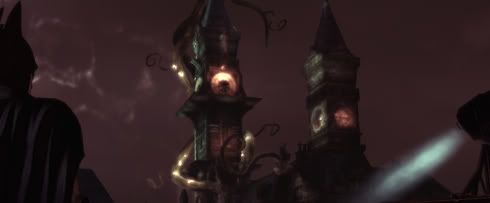
What is disappointing, perhaps by the potential of the source material, is how these elements in Arkham Asylum are not always given enough room to breathe. If the visual are beyond reproach, the architectural layout given to the stealth sections work better in theory than in practice. In this aspect it’s reminiscent of Deus Ex (2000), an excellent exercise in level design affected by creative myopia which shoved players into air ducts and maintenance tunnels when the need for secrecy came. It makes sense in terms of architecture but what this game deserved was a more organic design. This wouldn’t be bad if it only happened once or twice but a bigger problem arises when confined rooms where gargoyles and ducts are the only viable opportunity for stealth are followed by very large rooms devoid of any of these options or similar. Halfway through it all the obvious pattern shows itself: stealth in one area, forced combat in the next, a couple of tunnels and back to the start. It works, sure, but it could do better.
Which leads me to other patterns. Riddler in Arkham Asylum is symptomatic of modern videogame design in consoles; the trophy hunt that, in some way, has gone from curiosity into a sort of gamer validation through meta-gaming rather than gaming itself. Their biggest issue comes from the poor context. Riddler challenges Batman to use his detective skills but after solving the first riddle (something alarmingly mandatory in a game which excels at giving enormous freedom most of the time) there is no narrative obligation to find them. We’re left with the ludic obligation, since each trophy found and each riddle solved reward points used to bolster abilities – almost a necessity here. It’s disarming how close Rocksteady came to solve this problem. From beginning to end there is not one reason that justifies their presence in Arkham or to invest in the collect-a-thon… But when we finally track them all, Riddler mutters something about unleashing something on Gotham. This threat could have been given right from the start and in that case, would have benefited from a much needed contextual and narrative richness.
Perhaps the biggest disappointment stems from the Titans, a sort of steroid-fed monsters. During the game Batman confronts Bane, whose use of the Venom drug was responsible for Batman’s fall during the Knightfall saga in the comics (a series of events that led to the mental and physical breakdown of the Batman, the former literally as Bane broke his spine, something which went on to be fixed with the worst deus ex machina I can remember) and is a very important element in the game. Now, that someone tried to use this drug to mass produce an army of mutants is a pretty competent story hook but using the same type of enemy repeatedly, without variation or verve, is taking it a bit too far. Even more so when we’re talking about enemies with the same attack pattern used by Bane, thereafter repeated to exhaustion – ours and the dark knight’s own. When the ending finally arrives you can hardly believe the result and I’m left wondering if I should blame Paul Dini or Rocksteady for the bitter aftertaste. That the last “boss” forces he use of one our bat-gadgets is acceptable; that said device has been in our possession for a good part of the adventure but couldn’t be used the same way in the past during similar fights is incredibly frustrating.
Now, most of that sounded negative but lest you forget I like the game a lot. Part of that has to do with the power of the asylum itself, something I’ve already explained. The other reasons, of course:
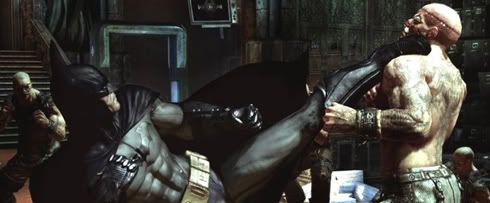
Rocksteady created a combat system that’s stupidly intuitive and dynamic. The word “stupidly” aside this might sound like a press release but it’s not. Freeflow Combat is one of the better combat systems I’ve seen in the last years (perhaps comparable to Devil May Cry 4 and the more recent Ninja Gaiden games). What others in the genre destroy through an absence of focus Rocksteady employed with confidence. For an instant Batman looks like the goddamn killer rabbit from Monty Python and the Holy Grail (with less blood and decapitations, natch) but the combat has a remarkable strength and physicality. It does not turn Batman into a superhero, it makes him look like someone trained in multiple fighting styles and someone in peak physical condition. Combat ends up being an expressive ballet, furious and graceful, that only requires spatial coordination on behalf of the player to launch himself against opponents and unleash BAT PUNCHES. How many studios would kill to have a combat system that simply works, is a pleasure to play, is seamless and actually shows how powerful a character can be without going all Matrix on us?
If it’s true that Joker’s constant presence steals Batman’s show, it is however the Scarecrow who has the most hallucinating moments of conflict. The introduction to this triptych of encounters uses a gradual tilt in perspective and absence of interface. It is not a cutscene, it is not one of those THERE IS NO CHANCE TO SURVIVE PRESS ‘X’ moments. It’s a logical extension of what’s happening to the character, an effect where style and substance are on the same level, where form and function become symbiotic. And moments later it deliciously subverts the kind of gamer who approached videogames from a purely technological perspective and can only appreciate “kewl grafix” – where seconds ago we could see a highly defined Batman, we are now in clear two dimensional platform game territory, here used as a psychological manifestation of the character (Batman feels helpless) and of Scarecrow’s influence (overwhelming, massive, chaotic). Surviving this area requires avoiding the gaze of a gigantic Scarecrow and beating him requires aiming a spotlight at him, and I think I don’t need to go particularly deep in explaining the symbolism of the light.
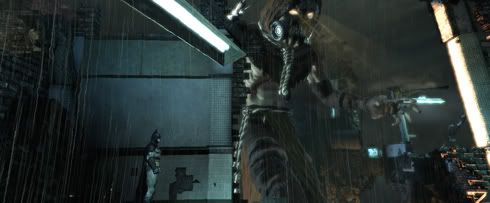
Unfortunately, Rocksteady realized this was a good idea and decided to repeat it two more times. If the pseudo 2D sections were more varied these would be classic moments. But after the first it becomes stale. Still, it’s those intros to the platforming that shine. When the third and last one comes we’re not sure what to expect. The first time is always the first time, the second does a good job of showcasing Batman’s origins while prepping us for another platforming section, this time with skeletons popping out of the ground. But now… Well, now it’s different. Special even, not because it’s radically new but because it manages to appropriate one of the stronger elements of Eternal Darkness: Sanity’s Requiem – the representation of insanity through gradual corruption of player perception. The screen freezes and fires graphical glitches in several directions. Then the darkness. Then the return of the introduction movie… Or is it? What seemed like a technical glitch, a game reset, is actually a twisted mirror that produces a world opposite to that which Batman and gamers are acquainted with. Batman is taken through a brilliant section – and it should go without saying that, as we take control of a certain character instead of the dark knight, this indirectly establishes a recurring aspect of his mythology, the chance that Batman and his nemesis are really each other’s reflection – and then…
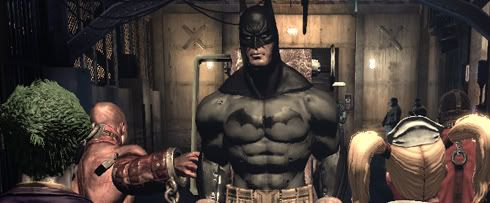
And then a pistol is aimed at Batman. The trigger is pulled and a bullet’s thunder darkens everything. In the screen, a small tip suggests we tilt the mouse to dodge the bullet and offers a chance to try again or quit. If you’ve lost before you recognize this screen to be a familiar fixture. Because of that, because you don’t expect the game to betray its own rules, you feel like Force Choking the guys at Rocksteady. “How could they turn this into a Quick Time Event?”. And when you select ‘Retry’, it all turns out to be an elaborate hoax, a cruel joke not out of place from Joker’s repertoire. Trying again simply sends us to the next and last platform section where we’re shown several Batmans that could have been – the lunatic, the animal, the frightened man. How is it possible that until today no one dared to explore these things with the bat, that no one had the necessary vision to risk this kind of idea in a game dedicated to Gotham’s vigilante? These may seem trivial post-Kojima but there’s no attempt to suggest genius through illusions of grandeur in the narrative here: these are simply small moments that break the fourth wall down to its most basic level, to the fundamentals necessary to move the experience along.
The only negative side effect to all this is that we may be staring at creative suicide – if it’s easy to imagine a sequel, then it’s also easy to ask how these concepts can be taken beyond. Hopefully Rocksteady will surprise us again if that day comes.
A smaller, but no less important, triumph is that we don’t get to drive the Batmobile. The vehicle is there but Rocksteady saw no reason to bloat the game with levels dedicated to drive around Gotham. For some this is something to be edgy about; to me it’s a victory over those who can’t let go of their chew toys. Arkham Asylum is primarily a game about the physical and psychological exploration of its main character, not a game that should throw everything into a blender to please a collective consensus. It’s no wonder those kinds of levels are often the ones to fade quicker from our memories. I’m going as far as to suggest that the scene where the Batmobilie is used in Arkham Asylum is a lot more memorable because it doesn’t overstay its welcome and does its job with style and elegancy. And when the Batplane enters the scene, well, it’s time to let out your best fanboy squeal. But these are tools for Batman, not the focus of his adventures.
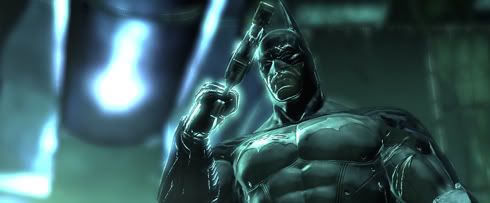
Through it all, I’m stuck with the idea that Rocksteady built the game around the character; that, unlike other games it’s the character that drives the game and not the opposite. When it stumbles it finds balance, when it falls it quickly gets back on its feet, and when it points to the starts but falls a bit behind them we give it the push it needs. There are some voices on the internet clamoring for a sequel that lets you drive the Batmobile and letting Batman loose on a vast, fully explorable city. To me this is a sign of not understanding the game. It is not called Batman: The Great Gotham Treasure Hunt or Batman: Uncharted: Gotham Edition. It’s not called Batman: Wacky Races in Gotham. It’s not a game that fixes its problems by spreading its design too thin – the game’s merit is precisely how it does away with the conceptual fat, and goes straight for the meat.

I hope Rocksteady don’t lose their vision. This game is a prime example of how less is more. There’s no need to make it the opposite. In short, Batman: Arkham Asylum is a good game, a very good game even, capable of holding out on its own and as an example of what it is to truly understand a character.
But it’s not a game about Batman or the Joker.
It’s about the asylum.
Thanks, Chris, glad you liked it
I agree that a clear focus, rather than a smothering in details, is best at making a game shine. I appreciate what they’ve accomplished with this game and even some complaints I did not express here – chiefly, the depiction of the serial killer Zsasz and the perhaps adequate-but-not-quite-vibrant encounters with Killer Croc – are easy to put aside when most of it is a clear triumph.
When I hit the “publish” button I had a feeling I was forgetting something about Carpenter’s movie but went on for days unable to remember what. Your comment made me realize what it was – that precise scene of suspicion and desperation during the blood tests!
I’d have to say the best answer is perhaps the second one – a chain of events that illustrate certain aspects of the character rather than one central event that escalates into a powerful moment of revelation. Admittedly, I have a tendency to overthink and overanalyze certain situations, but what I found best in the narrative were the subtle touches that lead into possible readings. The Arkham chronicles, for instance, are generally a series of descriptions that on their own would (and often do) fall flat but it’s the moment you collect the final one that reveals their true meaning. Unlike the graphic novel of yesteryear it’s more muted and not as explicit, but its discovery holds about the same power – linking Batman to the growth of the Asylum as an entity, as something that Batman has been feeding over the years (a “job” that the narrator of those chronicles believes the Dark Knight should carry on doing).
I found the Scarecrow encounters also pushed toward this, in the sense that they indirectly reveal Batman’s psyche through architecture and character design. The crumbling platform levels suggested a sense of Batman’s struggle, the chaotic landscape a direct representation of his mind and the more steady platforms the path he carved for himself (an anchor of sanity, if you will) during the nightmares. The last encounter in particular would probably benefit from not segueing into yet another pseudo 2D challenge as its first moments show those “would be” Batmans – handled in a different manner they could be much more revealing.
(A couple of these show Batman suddenly turning into Scarecrow and back, possibly suggesting not only Crane’s constant mental attack but also the possibility that Batman sees in Crane a different kind of reflection – after all, both cause fear on their enemies on not-so-different levels. This, coupled with the sequence where Batman trades places with the Joker, often suggest each major foe has *something* in them that can be constructed as a twisted version of Batman).
There are also times when you can revisit a certain area and find the Joker behind a reinforced glass room, and he’ll go on about certain aspects of Batman’s character and past. It’s a one-way channel into the man behind the cowl, though, as it is not a cutscene. Batman remains under our control but silent, only hearing what Joker has to say.
I’d be interested to hear your thoughts once you play through the game, though
Wow, that was one hell of a complete review! Loved it.
If anything, I noticed that the failures in this game only accentuate its good parts. I’ve often found that a flawed diamond is far more interesting, and beautiful, than a perfect one. And this sounds exactly like the kind of game that I can spend a lot of time with and get to know its unique charm. Ironically, your review does a far better job of convincing me that I need to buy and spend time with this game, than the all-glowing and overtly hyperbolic reviews that focus only upon its positive aspects. I can appreciate a game that focuses upon its subject rather than trying to encapsulate all of it.
One things remains uncertain though, and it’s partly owing to your comparison with Carpenter’s “The Thing” (one of my favourite films). There is a scene in that movie, that I think owes its entire possibility to the space that the science station, the ice, and the characters, set up together. It is the scene when they decide to “test” one another for the alien. While it happens half-way through the movie temporally, the entire narrative focuses upon that moment. It is when the characters finally reveal how horrific the situation is, how they suspect one another, and how inhuman they have become in their desperation. The ice surrounding them that encloses and chokes them into this situation, is not the subject matter of the movie, but the supporting background.
So the uncertain aspect of it – does Arkham Asylum have this kind of focal moment in which the horror/desperation/pain/tension/background of Batman is subtly revealed? Do I learn something about his (in)humanity as the narrative comes together to make one scene possible, or is it more of a chain of events that give me a flavour for his life?
I guess I’ll have to play to find out.